🆕New/Updated Information
Show Choir Experiences for Middle School?
One of the exciting developments in our middle school music program is the introduction of more show choir-style experiences for our students. We’re moving beyond traditional choral singing to incorporate choreography, movement, and performance skills.
This past week, our seventh-grade choir students spent time at St. Ambrose University learning choreography. They worked hard, learned quickly, and demonstrated a willingness to try something new. For some students, particularly those who might not ordinarily choose to dance, it meant stepping outside their comfort zones!
Show choir combines singing, movement, teamwork, and stage presence. It challenges students to develop several skills simultaneously while building confidence as performers. We’re excited to bring more of these experiences to our middle school students rather than waiting until high school.
Opportunities like this take the efforts of many people. Thank you to Mrs. Corcoran, the teachers who adjusted their schedules, St. Ambrose University, our volunteer chaperones, Music Boosters, and our parents for helping make this experience possible.
Public Money for Public Schools?
Two statements are frequently repeated in discussions about Education Savings Accounts (ESAs): “Public money should go to public schools” and “ESAs take money away from public schools.” Both sound convincing. But do they stand up to closer examination?
Let’s start with the first statement. Public money is regularly used to provide services through private organizations. Medicare and Medicaid help pay for healthcare at private hospitals and clinics. Government assistance helps families pay for childcare at private facilities. SNAP is used at Hy-Vee, Walmart, and countless other privately operated stores. Federal financial aid can help students attend private colleges and universities. In each case, public funds serve a public purpose, even though the organization providing the service is not operated by the government. Why should K–12 education be any different?
The second statement, that ESAs take money away from public schools, also deserves examination.
Public schools receive funding based largely on the number of students they educate. More students yield more funding; fewer students mean less. Public schools also receive certain funding for students attending nonpublic schools, even though those students never step foot in a public school..
Some argue that ESA dollars could instead have been given to public schools. That is certainly a spending choice the legislature could have made. But money that could have been allocated to public schools is not the same as money being taken away from them.
Perhaps the most important question is one that often gets lost in these discussions: Who is public education funding intended to benefit—the schools or the students?
Don’t get me wrong. I support both public and accredited nonpublic schools. A thriving community needs good options for both. Educating children is a public good, and public funding can serve that purpose regardless of which school they attend.
📌Still Relevant
Save the Date: “Made for More: Visions of the Promised Land”
OLV is hosting the multimedia event, “Made for More: Visions of the Promised Land,” featuring national author/speaker Christopher West and musician Mike Mangione on Thursday, November 12, 2026 from 7:00-9:30 pm in the church. Cost is $30 per person.
This program explores life, love, and human destiny through the lens of Pope John Paul II’s Theology of the Body. It weaves together live music, spoken word, sacred art, and video clips into a reflective multimedia experience. CLICK HERE for a video clip.
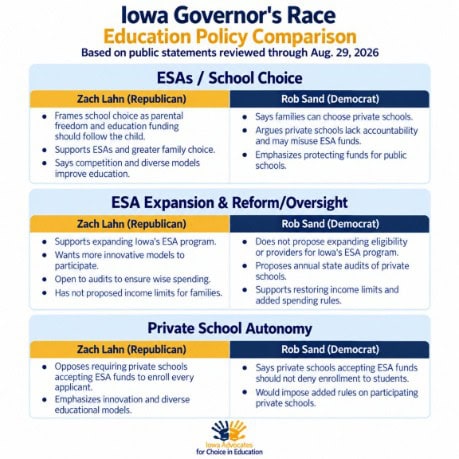
ESAs and Iowa’s Governor’s Race
Below is some information about each candidate’s position in relation to ESAs.
Music Program Poinsettia Fundraiser 
The music program’s poinsettia fundraiser has begun. Order sheets were sent home last week. Families may either return the paper order form or scan the QR code to complete the online form. All order forms and payments are due to Cris in the office by Thursday, November 12th.
Altar Servers Needed
Sign your student up to altar serve at a weekend Mass.
I-Ready Math Requirements
I-Ready use can help your child’s math skills.
I-Ready provides personalized math lessons online based on each student’s needs. Students use I-Ready for at least 30 minutes per week at school, enough to complete at least one lesson. Unfinished lessons will be assigned as homework.
Students who are not proficient in math based upon screeners or ISASPs will also be required to use I-Ready outside of school hours, reinforcing the school/home partnership. All students may complete additional lessons at home.
Checking Students’ Grades and Missing Work
Use the instructions below to check in-progress standards grades, missing assignments, and Assumption Algebra grades in PowerSchool. Directions are included for both the computer portal and app.
Please note:
- Some features are only available on a computer.
- Ignore the “Grades disabled by school” message. It does not apply to our standards-referenced grades.
📚Learning Habits Matter
Board Games and Mathematical Thinking
Family game night might be doing more for your child’s math skills than you realize.
Many familiar board and card games involve mathematical thinking, even when no one is consciously practicing math. Counting, recognizing patterns, predicting outcomes, and developing strategies are all important mathematical skills.
Here are some examples across grade levels:
PK–2
- Hi Ho! Cherry-O: Counting, adding and subtracting, and understanding quantities
- Uno: Matching, sorting, and recognizing patterns
Grades 3–5
- Yahtzee: Addition, probability, and making decisions
- Monopoly: Working with money, calculating costs, and planning ahead
Grades 6–8
- Chess and Mastermind: Logic, deductive reasoning, and strategic thinking
- Ticket to Ride: Comparing options, planning routes, and making decisions
The best part? Children can practice mathematical thinking without feeling like they’re doing math homework. And families get to spend time together in the process.
🗓️ Highlighted Events
Multiple calendars are available at www.jfkcatholic.org/. A one-page summary calendar is on the school homepage, with detailed calendars available under Calendars at the top of the website. Click any underlined event for more information. Below are a few highlighted events:
- Oct 26: 7th to AHS.
- Oct 27: Coffee & Crumb Fundraiser. Girls VB Pictures
- Oct 28: Hunger Drive Pick Up
- Oct 29: 8th Grade Pumpkin Drop
- Oct 30: Black/Orange Dress Day. End of 1st Qtr. 2 Hr Early Dismissal. No 4/5 YO PS Classes. Trunk/Treat
- Nov 1: “Fall” Back Time Change.
- Nov 3: SAU Honor Band
- Nov 5: Youth & Family Engagement Mtg
- Nov 6: JFK Night at QC Storm
- Nov 7/8: OLV Bazaar
- Nov 9: Bubbas 33 Dine & Donate
- Nov 10: 1st Reconciliation Retreat
- Nov 11: No Buses. Red, White, Blue Out of Uniform. Veterans’ Day Event
- Nov 12: Made for More Mission. 8th to Career Fair
- Nov 16: 8th to AHS
- Nov 17: Home & School
- Nov 18: AHS Fall Info Knight
- Nov 20: Ronald McDonald House Out of Uniform fundraiser. H & S Ladies Trivia Night
- Nov 23: 5-8 Festival of Trees
- Nov 25-27: Thanksgiving Break. ECLC Open on the 25th.
- Nov 30: No buses
💭Personal Sharing
As the weekend approached, I felt kind of left out of the conversations around school. Without little kids or even teens of my own, I had nothing to share regarding planning Halloween costumes, trick-or-treating, or haunted housing. I need some kids again!
Chad